> For the complete documentation index, see [llms.txt](https://docs.decube.io/llms.txt). Markdown versions of documentation pages are available by appending `.md` to page URLs; this page is available as [Markdown](https://docs.decube.io/databases/oracle.md).
# Oracle
Add Oracle as a decube connection and help your team discover, document and monitor data assets to drive data-driven insights and decisions.
## Supported Capabilities
{% tabs %}
{% tab title="Supported Capabilities" %}
**General**
* **Metadata** — metadata extraction and display of asset information (tables, columns, schemas). Types collected: Schema, Table, Column
* **Profiling** — data profiling on the Profiler tab
* **Preview** — sample data preview
* **Data Quality (Classic)** — data quality monitoring and observability
* **Configurable Collection** — selective ingestion of schemas/workspaces in Data Source Management
* **View Table** — view tables, which are virtual tables based on SQL queries
**Data Quality (Classic) Monitors**
* Freshness
* Volume
* Field Health
* Custom SQL
* Schema Drift
**Lineage**
* **View Table Lineage** — tracks virtual tables (views) and their data dependencies
* **Foreign Key Lineage** — tracks relationships between tables via primary and foreign keys
{% endtab %}
{% tab title="Not Supported" %}
**General**
* External Table
* Stored Procedure
* Data Quality V2 — not supported yet
**Data Quality (Classic) Monitors**
* Job Failure
**Lineage**
* External Table Lineage
* SQL Query Lineage
* Stored Procedure Lineage
{% endtab %}
{% endtabs %}
## Connection Requirements
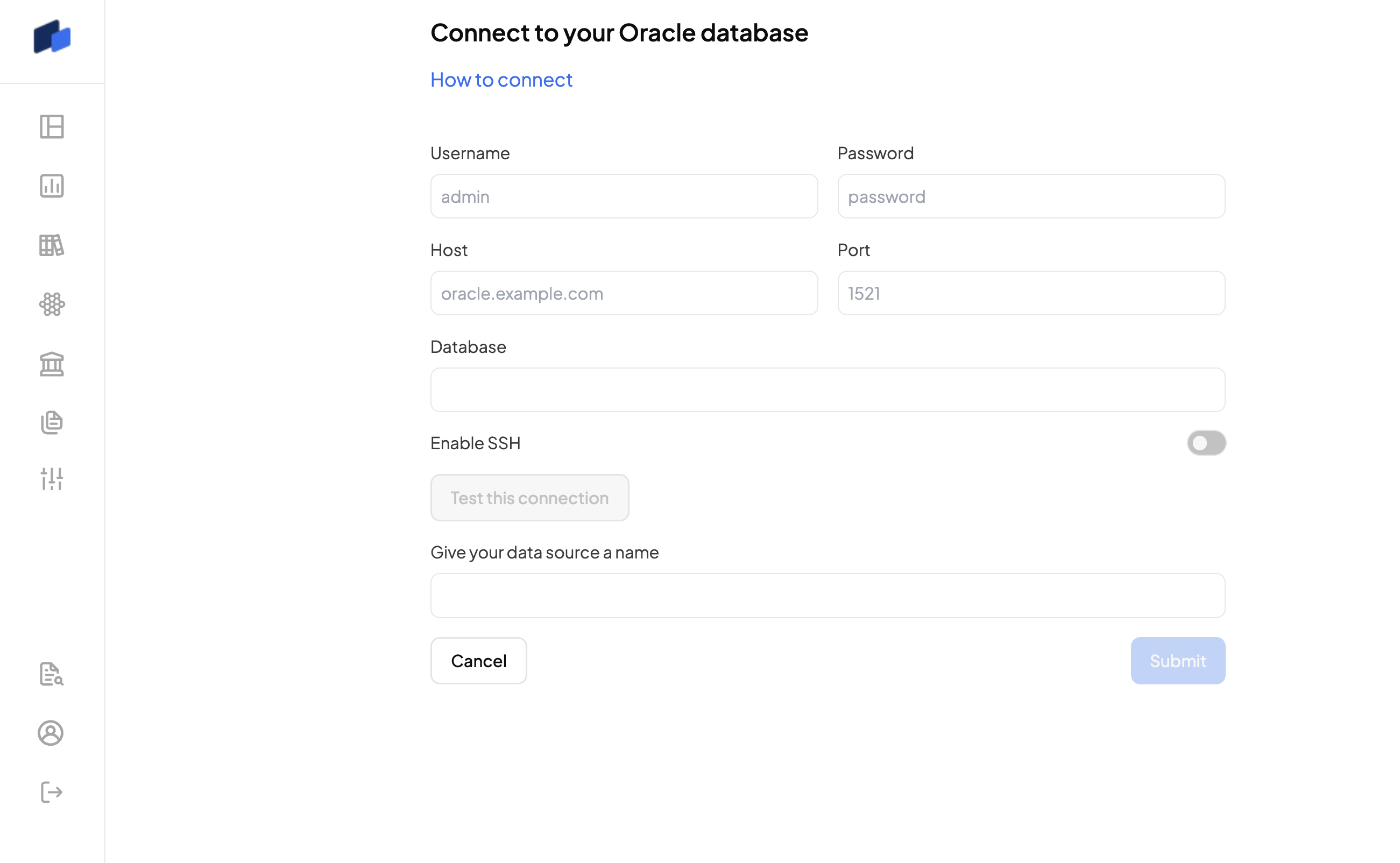
Connecting to decube is as easy as providing us with read-only credentials to your Oracle database. At a minimum, we require
* `Username`
* `Password`
* `Host`
* `Port`
* `Database`
Oracle
### Create User for Decube
A custom user would allow for a granular configuration of the user on your database and your connection to decube.
1. Create the user, and change password accordingly.
```sql
CREATE USER 'decube' IDENTIFIED BY '';
```
2. Grant `read-only` privileges on all data dictionary views
```sql
GRANT SELECT_CATALOG_ROLE TO 'decube';
```
3. Grant access of tables and views to the decube user. Here `table` or `view` can be `*` if you're using decube to observe the whole database. For only a few tables, you'll have to run this command multiple times changing the `table` or `view` value.
```sql
GRANT CONNECT TO decube;
GRANT SELECT ON .